Skip hire route planning
Route planning for skip hire is not route planning.
A route planner arranges stops. A skip firm’s day is decided by which empties are in the yard, which fulls are coming back, where each one tips, and the times that were promised. SkipDeck puts all of it on one board — deliveries, collections and exchanges together, timed on real road journeys from your yard — and you decide what goes where.
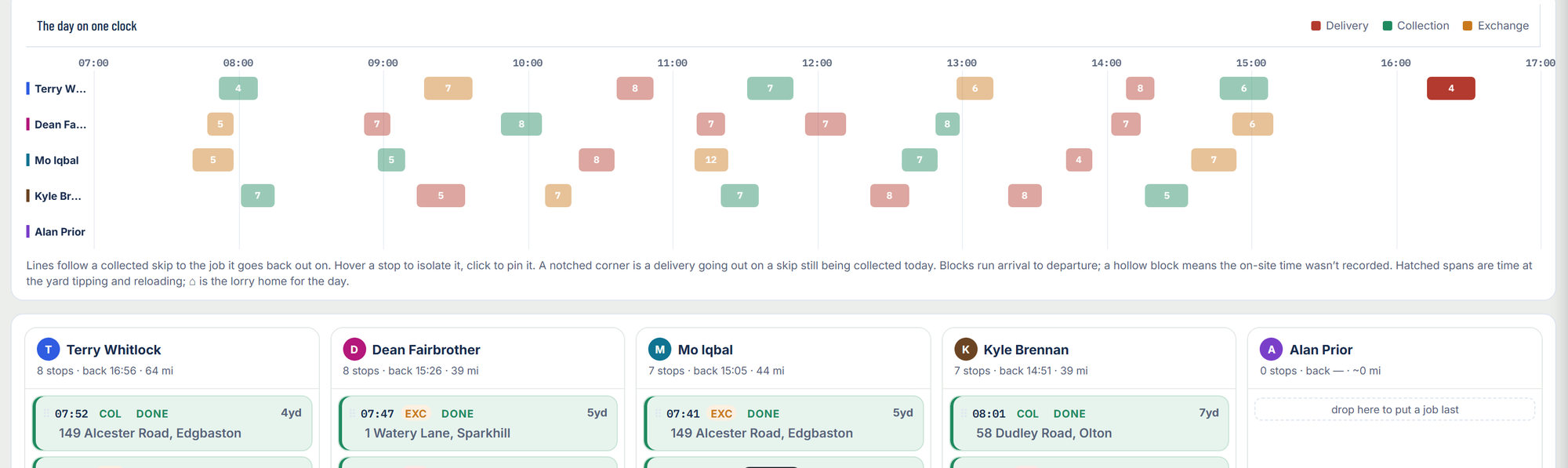
The board · real screen, swipe it to see the rest
No card and no sales call. We set the book up at its own address, usually the same working day.
Four things a route planner cannot see.
Distance still matters. It is just not the thing that decides whether tomorrow fits.
A delivery needs a skip that exists
A route planner sees an address. A skip firm sees an 8-yard delivery at nine that needs an 8-yard empty on the lorry at half past seven — which means one in the yard, or one coming back off a collection first. The shortest route through the stops is worthless if the lorry arrives with the wrong skip on it.
An exchange is one visit, not two jobs
Empty on, full off, same stop, same lorry. Treat it as a delivery and a collection at the same address and a route planner will happily send two lorries, or one lorry twice.
Every full skip has to go somewhere
A lorry carries one skip. After every collection it is going to tip — your own yard or somebody else's site — before it can do anything else. The tip runs are the real shape of the day and a stop list never shows them.
Agreed times are promises, not preferences
“Between eleven and one” was said to a customer. A day plan has to land the stop inside it and show the minutes to spare, with the driver's start, finish and break in the same sum.
Real roads, real lorries, real times.
Journey times come from the road network, driven at the speeds a lorry actually manages on that kind of road — not a straight line and not a car’s satnav estimate. Each driver’s start, finish and break are part of the plan, so a day that keeps its promises is a day the driver can actually work.
- Deliveries, collections and exchanges on one board, across every lorry that is in
- Yard returns for tipping and reloading in the run where you can see them, not discovered in the afternoon
- Agreed windows on the stop, with the minutes to spare beside them
- The right empty in the yard for every delivery, or the delivery does not go
- Work with no lorry yet stays in front of you rather than dropping quietly off the day
- Each driver’s run on their phone, in the browser, with nothing to install
The day is yours to arrange.
Every stop is where you put it. What the board adds is the arithmetic you would otherwise do in your head at half past six in the morning — the journey, the window, the empty in the yard.
A lane for each lorry
Say who is driving and what is in the yard, and the day opens as one lane a driver with the morning's work beside it.
Put the stop where you want it
Drag it, or move it with the keyboard. The lane reckons its times again around where it landed — on road journeys from your yard, not straight lines.
The times you promised
A job agreed between eleven and one carries that window on the board, and the stop shows how many minutes it has to spare.
The driver sees their own run
Every driver has a private link to their lane and nothing else. The photographs, the signature and the weight come back down the same wire.
Put tomorrow on the board with your own jobs and your own lorries.
Fourteen days, no card. Import the jobs you already have from your own spreadsheet and put a real week on the board. Or look at the board itself first.